

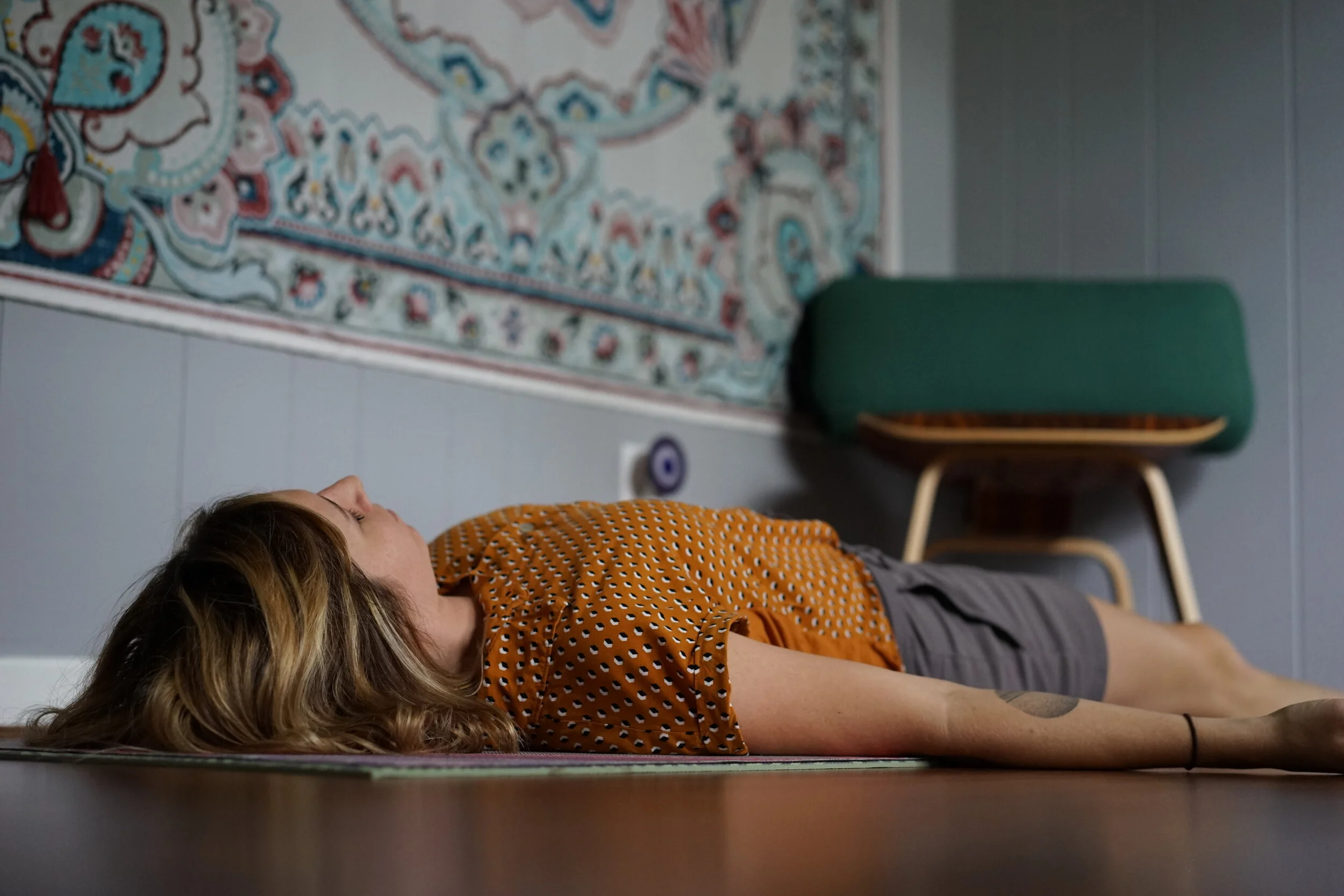
Ease + Release - Body Scan
To listen to this guided meditation (recommended), please click here.
Today, I want to lead you through a body scan meditation. You may choose to read through this entire blog post first + then lie down to try the scan. Or you may read shorter sections + try relaxing while reading.
Lie down if you can + get comfortable – we’ll be here for a bit. I recommend placing a bolster or pillow under the knees to help prop them up + support the low back. You may choose to place a blanket under the ribcage to help open your heart space as well.
When you’re ready - take a few deep breaths to begin. You can keep breathing in this manner – slow inhale, easy exhale – or allow your breath to return to normal.
As we scan the body, try to release any judgments of doing this right or wrong. Try not to attach to any thoughts that may arise. If your mind starts to wander, that’s ok. It’s normal. Just allow your attention to come back to these words. Let’s get started.
Bring your awareness to your face. Is your jaw tight?
Can you soften the closing of your eyelids?
Notice any tension in the face + just let it melt into the earth behind you.
Next, observe your shoulders – are they tense? Can you focus the breath there? With each inhale, bring in ease; with each exhale, relax.
Next, be conscious of your heart space. Can you breathe fully + deeply into your heart? Is there any constriction or maybe walls surrounding your heart? Soften here.
Move your focus down into the belly – with each breath in, let your belly rise to the sky. With each breath out, it melts back into your center. Again, breathe in, belly rises. Breathe out, belly melts.
Now soften your low back - let it grow heavy into the earth. Note any tension in the glutes. There’s nothing to hold onto – no need to grip. Allow the earth to fully support you here.
Note any tightness in the hips. Can you bring your breath’s awareness there? Inhale – invite in a sense of ease and softening. Exhale – relax, let go, release.
Coming down into the legs – recognize how hard your legs work day in + day out to carry you around. Let them be soothed here. Inhale ease… exhale release. Soften the quads, the knees, your calves, even the ankles relax here. Release all tension from the legs fully.
Lastly, notice your feet. Maybe scrunch the toes, create some tightening – inhale – then slow exhale, the toes are free.
Pause here + take 5 slow, deep breaths.
Observe any lasting tension in the body. Bring a soft focus there – envision a bright red light circling that area of the body – as you breathe, that red light starts to travel down the body, out the feet, + into the earth. Pause. Ground down.
Release. Release. Release.
Take a deep breath. Start to invite awareness back into your body. Begin to make small movements – wiggle fingers, toes. Stretch the body long – deep inhale. Easy exhale.
Release the Weight of Worries
To listen to this guided meditation, please click here.
Take a few deep breaths and ground down.
I want to take you back in time.
Imagine you’re about 3 or 4 years old. What do you look like? What are you wearing? Where are you? Your childhood home? Your favorite hiding spot? At school? With your friends? Where?
I want you to imagine you’re wearing a backpack. It’s your favorite color and not yet filled with a single thing. It weighs almost nothing… You start to walk along the timeline of your own life. Still wearing the backpack. Passing ages 4, 5, 6…
Now think about you at age 7 or 8. How have you changed? Has anything in life been difficult yet? Maybe there are obvious answers – family issues, loss of some sort, or death. Maybe you just don’t feel completely seen or understood at this age. Whatever it is, you place the weight of that worry or grief into your backpack. And you keep walking…
You meet your 12-year-old self. She or he is deep in that awkward stage. Glasses, bangs, braces, acne. You haven’t quite hit your stride yet. You feel shame for not being prettier, skinnier, smarter, more athletic. You throw the weight of that shame into the bag - you’ll deal with it later.
Now you pay a little more attention to the bag - you notice its weight more and more.
Walking along, envision 17- or 18-year-old you. You’re finishing high school and maybe headed to college. Lots of big shifts are on the horizon. A lot more responsibility is being placed on you + no one has really taught you how to deal with that. Take the weight of that + place it into your backpack. Now the bag is more noticeable – not yet unbearable. But carrying that around with you is exhausting + limiting.
You walk along… think about being 21 or 22. Maybe you’re out on your own for the first time. You’re attempting to make something of your life + maybe trying to get your first job but you’re met with rejection after rejection. You start to think you just must not be good enough. So you add in a little more weight for the worry of what your future holds. The weight of shame for not measuring up to what has been expected of you. The weight of isolation of feeling lost + not enough but being unable to share that with others.
The backpack gets heavier with each step. Your shoulders are tight—burdened by the weight of the pack filled with disappointments + fear + pain + loss. You continue walking… past mistakes + let downs + people you kept in your life for far too long. There’s a heaviness in the pack. Some of it doesn’t even feel like yours to carry. Your shoulders ache, you are tired from walking.
You carry on, collecting more fears + rage + confusion + isolation. Each emotion adds more weight to the bag.
Then you meet yourself at your current age. The pack so full, so nauseatingly substantial- you’re not sure it’s worth going on.
Pause. Take a few deep breaths. Close your eyes for a moment.
Just up ahead you see the edge of a cliff. You walk - still wearing the pack - to the ledge and pause. You see a sign nearby that simply reads “unload bags here”. You are hesitant. You’ve carried this bag with you for years… decades. Its heaviness has become a part of you. You even identify part of yourself as the pack. But then you ask yourself - what do I gain by holding onto this bag? Do I really need to hold onto the years of worry + fear + anger + suffering? What am I so afraid of happening if I release this worry + control?
You finally decide to empty the contents of the pack over the ledge. A lifetime of burdens lift from your shoulders. You stand taller. You breathe easier. You feel free from the worry + fear + sadness you’ve been carrying around. As you walk away from the cliff, you make a decision.
From here on out, you choose to fill the pack with positive moments + peace + ease + joy. Things that are much lighter + easier to carry with you along your journey. The fear + worry + pain – they’ll still show up in your life. But you learn to sit in those moments + just feel your feelings rather than adding the weight of them to the bag to deal with later. In those moments, you imagine the weight of the heavy + dark emotions simply falling off the ledge of the cliff.
And so you forge ahead, backpack in hand – light as can be.

Why I Journal
I journal to release the constant, running thoughts in my brain onto the paper.
I journal to rewrite my own story.
I journal to catch myself speaking unkindly to me.
I journal to create, to heal, to grow.
I journal to slow the fuck down.
I journal for me - to mother myself + unlearn my past conditioning.
I journal for my marriage - because it’s cheaper than therapy 🤪.
I journal as future me - she is bold, peaceful, kind, giving, creative, proud, and a badass boss bitch.
These pages are a place for me to be unapologetically me.
Want to journal but you aren’t sure how to start? Check out my journal, Me Here Now, here.
Need some more inspiration for your journaling journey? Here are some of my favorites:
+ @the.holistic.psychologist - Dr. Nicole is the creator of the [FREE!] Future-Self Journal which allows for space to observe and change behaviors, thought patterns, and reactions so you become more aligned with your… you got it, future self!
+ @inspiredtowrite - Every time Amie posts, I am reminded that I am worthy of making art, deserving of rest, and that mothering myself on the pages is the key to healing. Her Compendium [$19.99] is a great tool if you aren’t sure what to write about in your journal. She offers 31 prompts to get you started!
+ @fiveminutejournal - This is how my journaling journey began! With the 5-minute gratitude journal [$24.95]. Each morning, you briefly share 3 things you’re grateful for, what would make today great, and your daily affirmation(s); each evening - 3 things that were amazing in the day and ways in which today could have been better. This is great for starting out because you’re given a simple guide to follow and it takes just 5 minutes each day!
News Consumption for the HSP (Highly Sensitive Person)
We’ll talk about HSPs later, but I think we can all relate to the overstimulation of the news currently. It’s readily available at our fingertips on EVERY app we check. It’s in our faces + it’s devastating. I have ignored the news for years because it overwhelms me, but we (HSPs, white people, ALL of us) cannot turn away from it completely any longer. Here are some tips - if you’re an HSP, “overly” emotional, or just feeling drained these last few weeks - that may help with your excessive media consumption:
+ Breathe. Right now. Five slowwwww, deep, belly breaths.
+ Hydrate. Seriously. Grab a glass of water right now.
+ Each time you open a social media or news app, set a timer for 5-15 mins.
+ iPhone users: set daily limits/caps to your social media apps; I recommend setting not just a 1-hr time limit each day but also a limit between 9pm-10am (or whatever works best for your schedule).
+ Control who you follow + where you get your news from; choose news sources wisely + dedicate time to reading the actual news vs. scrolling endlessly on IG.
+ Sit with your feelings after viewing a story — don’t push past + keep scrolling + to try and see the whole internet in one day.
+ After your timer goes off, put the phone down + get moving; get outside - walk, stretch, breathe in the fresh air. Set another timer for rest/ play if need be.
+ Fill your feed / time with humor + joy + self-care + connection with friends + etc. to balance the consumption of news/ tragedy.
+ Show yourself some compassion + take breaks whenever you need to.
Lessons from Training for My First Tri
Sunday would have been my triathlon. I thought I’d be upset that it got canceled, but I was quite relieved. I started training back in December and got more serious in February. I joined the gym for the first time in years so I could swim. I started running, despite hating it every single time. I lifted and biked and did crazy core things. I was the strongest I had ever been.
Then when the pandemic hit, I quickly replaced my training routine with a thousand excuses: the gym closed so no pool to swim in; it was too cold to swim in open water yet; there was too much rain to run or safely bike. (Not to mention the best reason/ non-excuse to take it easy: experiencing a fucking pandemic for the first and hopefully final time in my life).
But the whole point of training for the triathlon was never about winning the race. Yes, I wanted to complete it, but I learned so many more lessons along the way:
+ There’s a beautiful and delicate balance between strength and ease
+ Pushing until you feel pain is not only unnecessary but probably harmful
+ Forcing yourself to follow a strict workout regiment is not sustainable
+ Working 8-hour shifts on your feet while training means you need more rest than someone who sits at a desk
+ Recovery is so vital and there is no need for shame in allowing yourself to rest
+ Physical strength + mental resilience go hand in hand— one increases the other
So all of this to say… am I going to become a hard-core triathlete? Probably not. But I learned the value of gaining strength to feel better physically and mentally. I also learned to respect + honor my craving for rest and relaxation.
How to Begin a Better Routine
I’ve never been good with routine— I’m too “free-willed” as they say. But having a morning routine - especially now in quarantine- has helped me set a good intention for my day. So if you’re looking to get into a morning (or any time) routine, here are some tips to get you started:
1. START SMALL! SOOOOO SMALL! You want to do 100 pushups a day? Start by doing 3 pushups a day for a week. You want to write a book? Write for 5 minutes in a journal in the morning. You want to meditate and become enlightened? Sit in silence for 2 minutes a day. Want to boost your skincare routine? Begin with one simple step, not 4-5. Our brain doesn’t like change or newness so we often encounter a ton of resistance when starting a new habit (more on this at # 4). But when we can add in small actions step by step, it’s a little easier to trick our brain into sticking with it!
2. Only add one thing at a time. Trying to run, meditate, cook, AND stretch will overload your system. Start with just one! HINT: pick the easiest one to implement and remember, start small.
3. Track your progress! I’ve been using a “yes list”(photo 2) — a check-off grid for each item in my routine. It’ll give you a good idea of when you miss certain activities and why. (For me, my routine usually goes out the window on weekends and I don’t walk Beaux when it’s raining or too much else is going on.)
4. Stay consistent! That resistance I mentioned in # 1 is SO real! Whether it’s work, kids, laziness, or some other stressor - push past that mental resistance. Obviously, listen to your body if your routine involves running or something super physical - don’t push past pain. But try to follow through at least every other day. (Using the two-day rule here is a great way to give yourself some grace if you miss a day but promise to yourself you’ll get back to your routine tomorrow.)
#LettersToNonPresentMe
#LettersToNonPresentMe
To 15 y.o. me,
This darkness you feel will always follow you. [It’s normal; nothing is wrong with you.] You’ll carry it with you. Sometimes the weight will be unnoticeable. Sometimes, unbearable. But you’ll push through. You’ll use tools to help you accept every emotion, even the “scary” ones. You’ll harness the lessons you learn to guide others to healing. There’s no shame in needing help or feeling lost. You have all the answers within you.
Love,
32 y.o. me